

🧠 GEO: the next generation of SEO. How to make your brand visible in AI (ChatGPT, Gemini, Perplexity)
Introduction
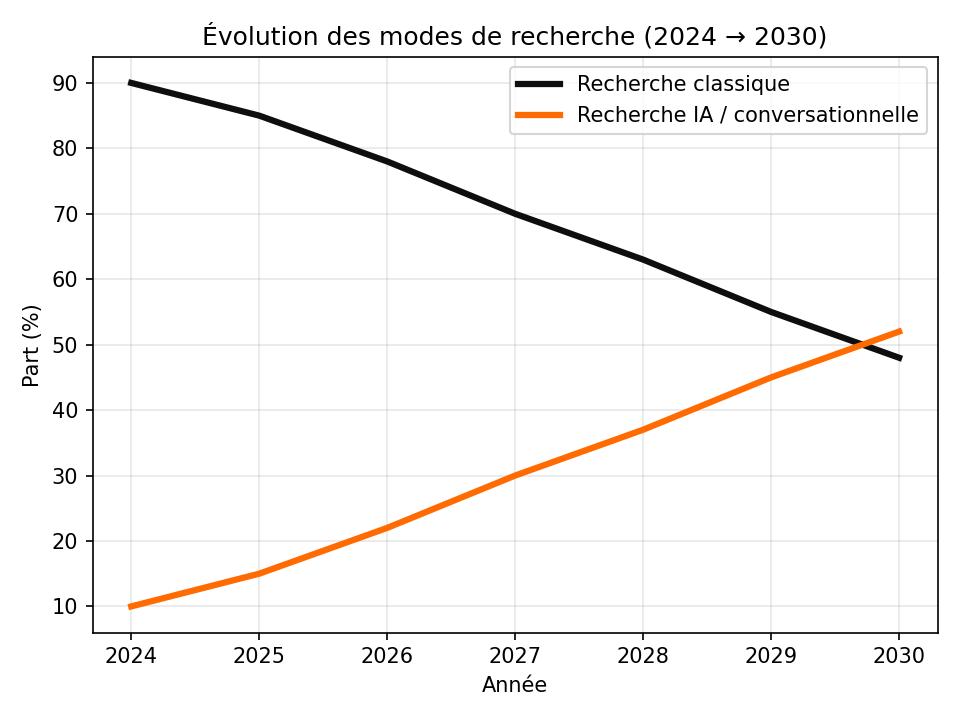
The web is undergoing an invisible but major transformation: a growing proportion of searches are no longer carried out in Google, but in ChatGPT, Perplexity, Gemini, Claude…
These conversational AIs don’t send back ten links: they answer directly.
Several studies have already shown that :
- Nearly half half of adults have used an AI tool (ChatGPT, Gemini…) to search for information.
- The use of LLMs for search-like applications is steadily increasing.
- ChatGPT now boasts hundreds of millions of weekly active users.
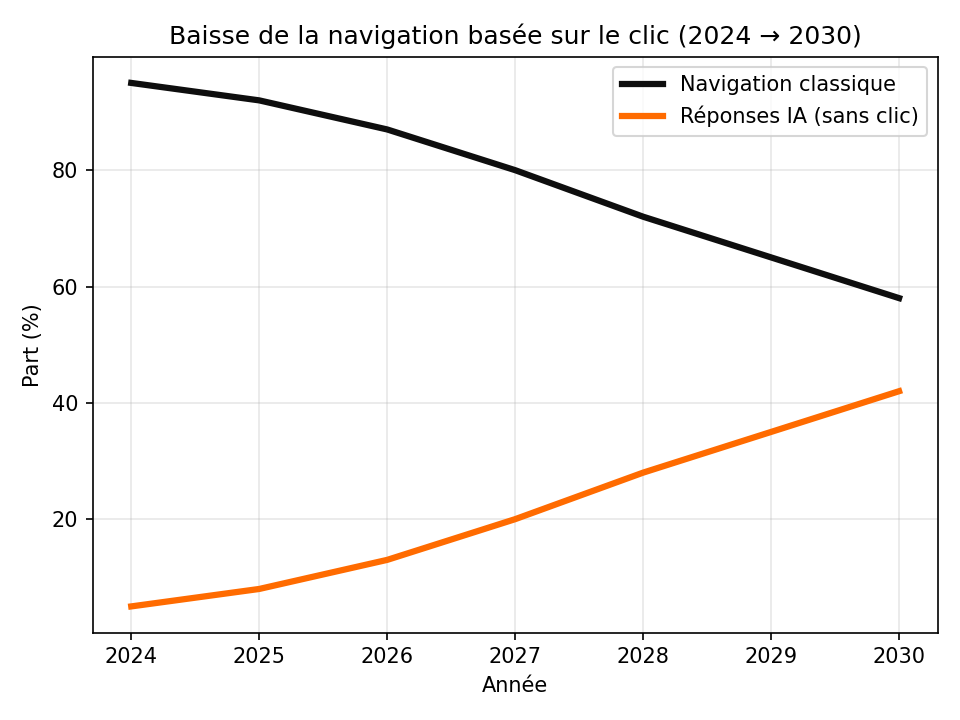
- AI Answers” integrated into traditional search engines (Google, Bing) reduce the number of clicks to websites.
These figures do not mean that traditional search engines are disappearing – but they do clearly indicate a shift underway: search is becoming conversational, assisted, summarized.
In this context, one question emerges:
How do you make your brand visible in AI-generated responses?
This is exactly what GEO – Generative Engine Optimization.
At Agifly, we have developed a methodology based on 5 pillars + an advanced 5B pillarwhich enables you to adapt your content to the actual criteria used by AIs to “choose” the sources they will reformulate, summarize or quote.
🔍 Why traditional SEO is no longer enough
SEO was designed for Google: tag structure, technical optimization, backlinks, internal linking… These elements remain essential, but do not determine in no way your visibility in a generative AI.
AIs :
- do not classify pages,
- do not return SERPs,
- are not based on backlinks,
- don’t display your titles / meta descriptions.
They :
- analyze,
- include,
- summarize,
- answer.
They focus on content:
- clear,
- hierarchies,
- without ambiguity,
- easy to reformulate,
- consistent throughout the site,
- based on defined concepts.
A highly SEO-optimized site can therefore be :
✔ visible on Google
❌ invisible in ChatGPT or Perplexity
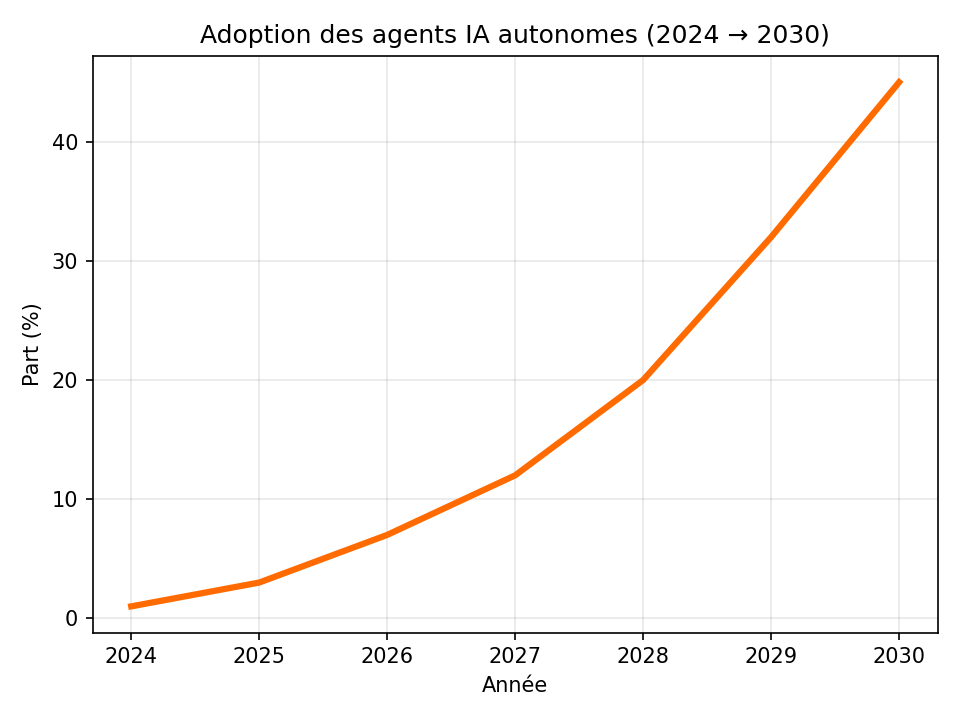
Some interesting data:
🔍 How do AIs choose their sources?
AIs don’t “guess”: they select what they understand best.
They prefer content:
✔ easy to extract
Short paragraphs, direct answers, isolated concepts.
✔ easy to synthesize
Logical structure, clear sections, well-mastered lists.
✔ globally consistent
Identical vocabulary, stable concepts, homogeneous narrative.
✔ unambiguous
Two contradictory formulations are all it takes for an AI to ignore your content.
✔ rich in semantic signals
Well-defined concepts, clear relationships between concepts, explicit named entities.
Google reads to classify. AI reads to understand and respond.
GEO optimizes this understanding.
🔧 3. Our GEO framework
We have structured our GEO interventions around 5 complementary levers.
🟦 Pillar 1 – IA citability audit
We analyze how AIs actually interpret your content.
The aim is to understand :
- what information they retain,
- of which they are unaware,
- where the ambiguities lie,
- why your competitors appear and you don’t.
This audit reveals the “AI readability” of your site before optimization.
🟦 Pillar 2 – Structuring & prioritizing content
AIs prefer sites where :
- one subject = one answer,
- a concept = a clear definition,
- one paragraph = one idea.
We restructure your pages so that they become understandable on the first passincluding a language model.
🟦 Pillar 3 – Editorial & terminological consistency
An AI doesn’t select a page: it selects a coherent domain consistency.
We work on :
- standardization of vocabulary,
- inter-page consistency,
- alignment of key messages,
- reformulation of fuzzy areas.
A coherent site becomes much more credible.
🟦 Pillar 4 – RAG-friendly optimization
Modern AI models incorporate RAG (retrieval augmented generation) to extract reliable content.
We make your pages :
- fragmentable,
- extractable,
- unambiguous,
- packed with useful information,
- easy to index.
This is a key asset for current and future AIs.
🟦 Pillar 5 – Golden Prompts: validation & perception IA
We test your brand through a series of strategic prompts:
- “Who are the experts in…?”
- “What is the best solution for…?”
- “Explain [your service] to me simply.”
This allows us to :
- to assess AI perception,
- measure GEO progress,
- identify editorial opportunities.
🟦 Pillar 5B – Advanced AI: competitive analysis & future strategy
This pillar is unique to Agifly.
We use AI to :
- Compare your brand to your competitors
AI often reveals angles or messages you weren’t aware of. - Detect blurred or missing areas
An excellent way to improve your editorial position. - Preparing your site for conversational search 2025+.
We optimize for AI agents, AI voice search, and autonomous assistants.
🚀 Our customers' results
After implementing the GEO :
- +40% visibility in AI responses (ChatGPT, Perplexity, Gemini)
- Enhanced editorial clarity and brand consistency
- Lower cost of acquisition (fewer clicks needed to inform)
- Classic SEO improvement (positive side effect)
- Better understanding of products/services by users
- Strong differentiation in competitive sectors
GEO-ready companies are those that will gain visibility in a web where search is becoming conversational.
🔍 Is your site visible in ChatGPT, Perplexity or Gemini?
Ask for our free GEO mini-audit :
You will receive :
- analysis of 3 key pages,
- IA citability score,
- comparison with competitors,
- 3 priority GEO actions,
- a synthetic plan to strengthen your presence in AI.
Or simply :
👉 Send us your URL and we’ll get back to you.
❓ FAQ
Does GEO replace SEO?
No. SEO = Google.
GEO = Visibility in AI.
The two complement each other.
How long does it take to see results?
Between 3 to 6 weeks depending on AI updates
Do we need to rewrite the whole site?
Rarely. 80% of the work consists of restructure, clarify, reorganize.
Is it compatible with WordPress, Drupal or Webflow?
Yes. GEO depends on the content, not the CMS.
Why do AIs sometimes ignore my site?
Often due to a lack of clarity, structure, coherence or semantic cues.
Is it an opportunity or an obligation?
In 2025, this is already a strategic advantage.
By 2026-2027, this will be essential.